
Troy City Directory Holdings
Troy has a real directory trail, although it is not one uninterrupted shelf. The strongest starting point is the Troy-Miami County Public Library catalog and the Local History & Genealogy Center. Catalog descriptions establish particular titles and volumes. They do not prove that every year between two listed dates exists, or that every volume is on a Troy shelf. Use the title, year, branch, call number, and library-use-only status as part of the citation for a directory find.
| Collection or record | Verified dates | Where held | Access route |
|---|---|---|---|
| Historic Troy newspapers | 1828 to 2014 | TMCPL | In-house Newspapers.com |
| Troy Times microfilm | March 1825 to October 1868 | THS and TMCPL historical collection | Microfilm research |
| Hollis and Oakes volume | 1898 sample | Local-collection lead | Historical Society newsletter evidence |
| Polk's Troy directory | 1962 and 1982 | Main Library, Dayton | Reference, library use only |
| Troy city-directory serial | 2002 Troy copy; selected later shared copies | Troy and partner branches | Reference, library use only |
| Troy directory microfilm | 1929 and 1933 | Cleveland Public Library | Outside-county fallback |
| Polk Troy directory | 2008 | Ohio Genealogical Society accession 55740 | Discrete accession record |
The available evidence supports selective year-by-year work. No verified Troy reverse or criss-cross directory run was found, and the public item data does not say whether a volume is alphabetical, street ordered, or a householder list. Ask the Center staff about an exact year before planning a trip or treating a catalog gap as a missing household.
The older Polk catalog record documents the annual series described from a 1962 issue through a latest issue consulted in 1982.
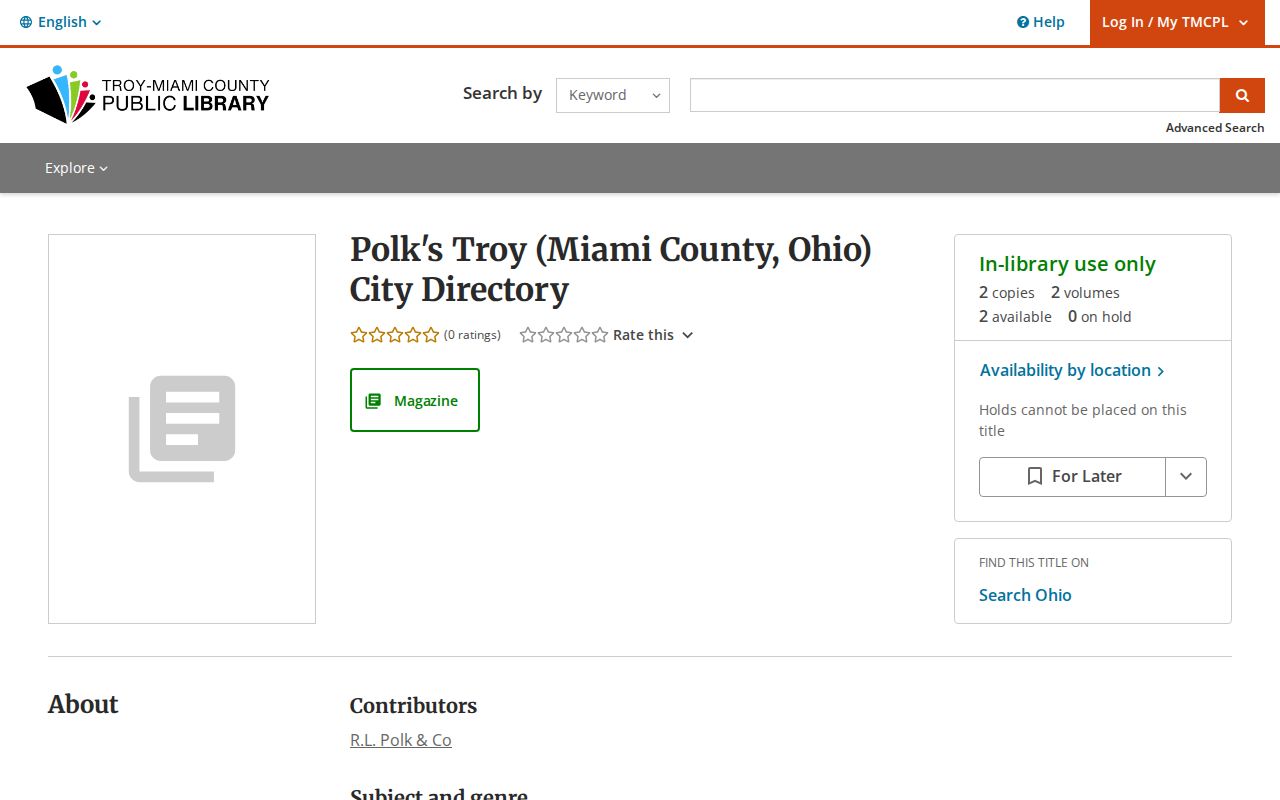
That record is useful evidence for those named years, not proof of a complete 1962 through 1982 run in Troy.
Troy's Local History Center
The Troy-Miami County Public Library Local History & Genealogy Center is the primary counter fallback for an older name or address. It is at 510 W. Water St., Suite 210, Troy, Ohio 45373, and its public phone is 937-335-4082. The Center lists books, maps, manuscripts, wills, land records, microfilm and fiche, public computers, digital resources, copying, and research help. Directory work often needs several of those tools at once.
Local History & Genealogy Center
510 W. Water St., Suite 210, Troy, OH 45373
937-335-4082
Listed research hours
Monday and Wednesday, 10 a.m. to 7 p.m.; Tuesday, Thursday, and Friday, 10 a.m. to 4 p.m.; Saturday, 10 a.m. to 2 p.m. Confirm hours before visiting.
The present Center formed when TMCPL and the Troy Historical Society moved to Hobart Government Center in 2025. Its local-history space began in 1960, the Historical Society began in 1965, and the collection had a former Fifth Third Bank location in 2003. Those moves explain where to go now; they do not mean every item was digitized.
- 1960: the library set aside local-history space.
- 1965: the Troy Historical Society formed and became a collection partner.
- 2003: the collection moved to the former Fifth Third Bank location.
- 2025: the library and Historical Society formed the current shared Center at Hobart Government Center.
TMCPL's in-house newspaper collection covers historic Troy papers from 1828 through 2014 and supports name, subject, and date searching.
A dated notice can test whether an address change, death notice, business move, or family event fits the directory year.
Note: A catalog entry or a newspaper hit is a lead, not identification by itself when several Troy people share the same name.
Troy's Polk Directory Spine
The later catalog serial is titled Troy, Ohio City Directory, published annually from 1985 with title variations. Volumes from 1993 through 2000 used a Polk title, while the title became Troy, OH Polk city directory from 2000 forward. The issuing-body notes also change across Equifax, Polk Directories, and Polk City Directories. Those facts describe publication labels, not continuous local holdings.
The live availability record identifies selected Main Library, Dayton reference volumes for 1985, 1986, 1989, 1991, 1993, 2000, 2001 June, 2002 September, 2005 March, 2006 March, 2007 March, 2008, and 2009. Bradford has listed 2001, 2002, 2003, and a call-number-labelled 2011 item. The specifically verified Troy Library copy is a library-use-only 2002 reference volume. A partner branch holding is not the same as a volume being available in Troy.
The later Troy directory catalog record identifies the serial and its publisher and title changes.
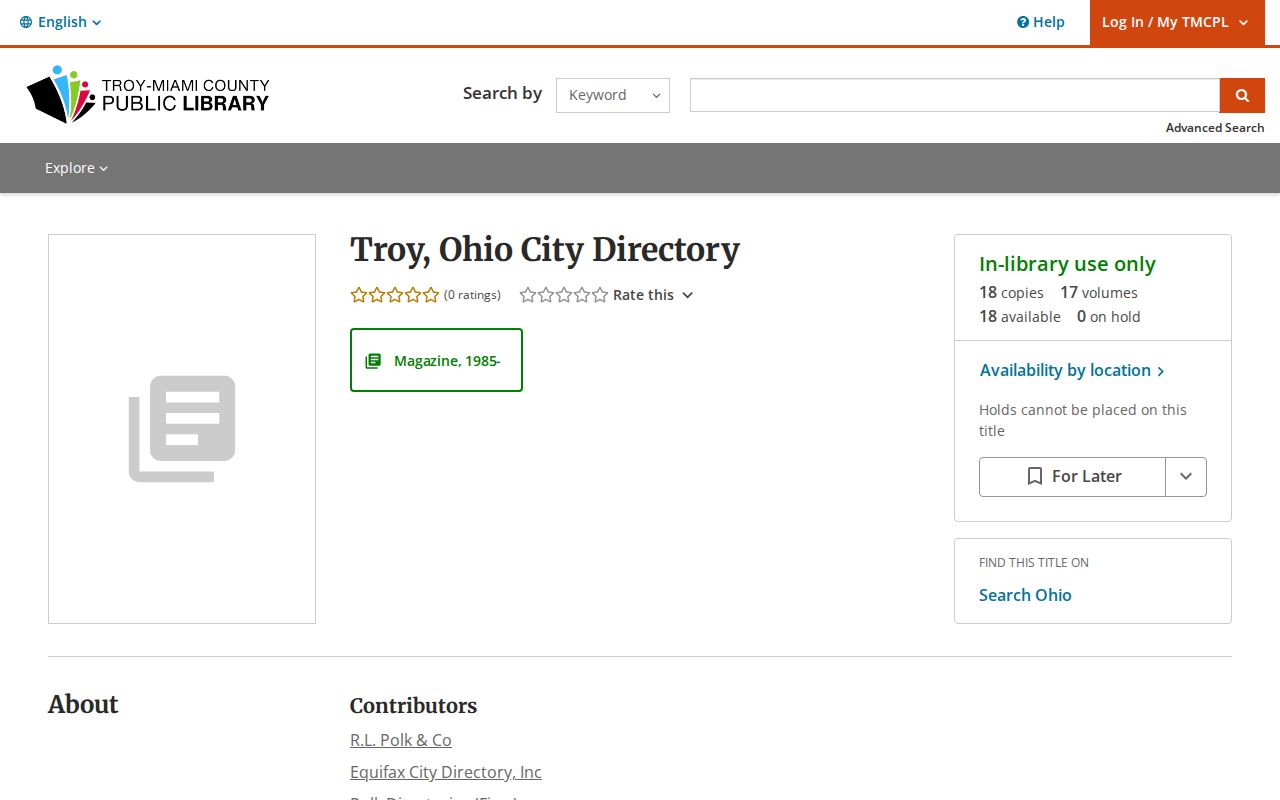
Use the serial record to locate a cited volume, then check the availability record for the branch and reference status.
The public availability endpoint displays branch, collection, call number, volume, status, and library-use-only information for the later serial.
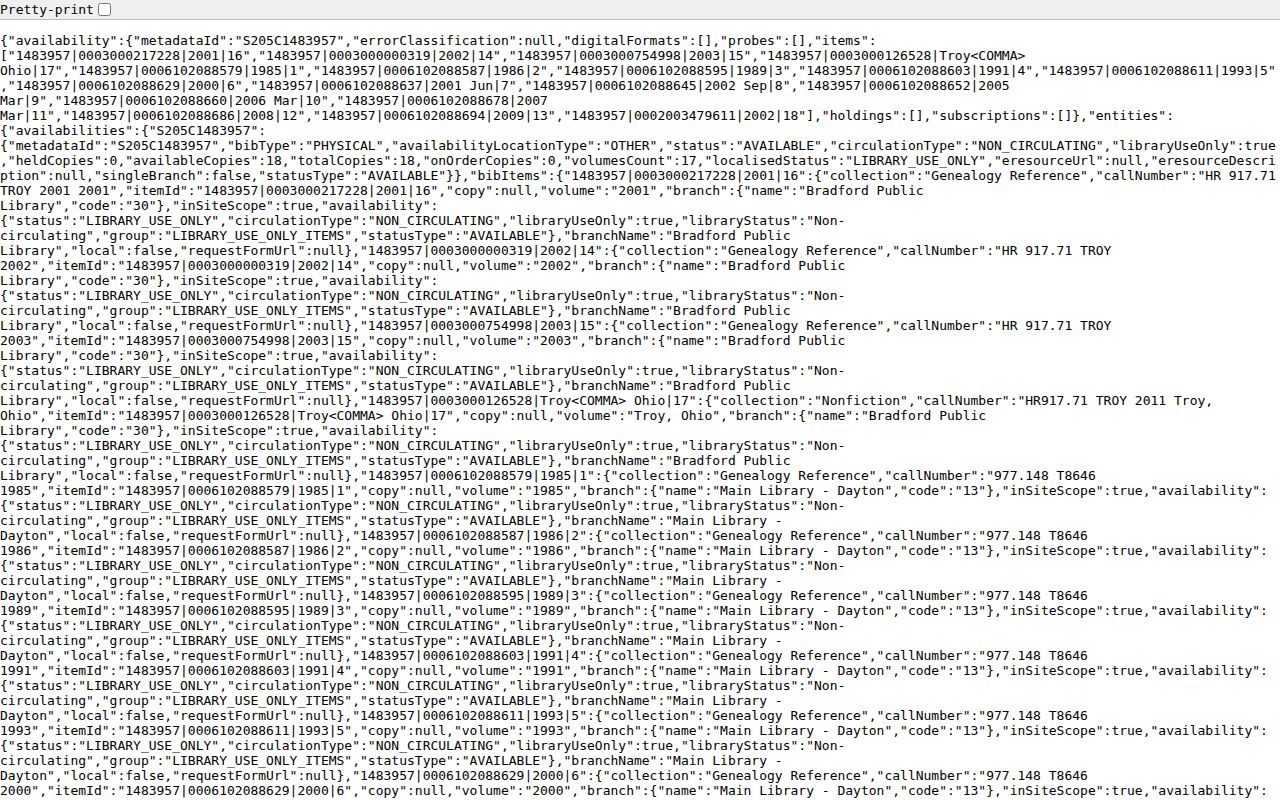
That branch-level evidence is why a researcher should request a specific year rather than assume a complete Polk sequence.
Reading a Troy City Directory
A Troy entry needs to be read as a dated record, not as a current address claim. The clearest local sample is a 1898 Hollis and Oakes entry for George Barton. It gives a residence on N. Cherry Street and a studio at Brown's New Block on Public Square. That separation is important: a business location and a home location can point to different places in the same entry.
| Personal name | George Barton in the verified 1898 sample. |
|---|---|
| Residence | N. Cherry Street, a residential location. |
| Business location | Studio at Brown's New Block on Public Square. |
| Publication detail | Hollis and Oakes, 1898. |
| Context to save | Exact spelling, page, title, year, publisher, and nearby street entries. |
Full local entries may use more conventions, but no Troy sample was verified for spouse, widow, trade, renter, owner, or abbreviation marks. Do not assign a local meaning to an abbreviation until the key in that actual volume supports it.
- Directory volume
- A dated published listing that can connect a name with a residence, business, or both.
- Residence and business address
- Separate locations that must be copied separately instead of merged into one assumed home address.
- Criss-cross directory
- A directory arranged by address or street. No verified Troy title or year run supports claiming one for a particular volume.
- Reference-only copy
- A volume meant for use in the library rather than checkout, often because it is a local research source.
Troy Newspapers Between Directory Years
Newspapers can connect adjacent directory dates when a title has a gap or a person vanishes from a listed volume. TMCPL names the Troy Times, Buckeye, Miami Union, and Troy Daily News among its searchable historic titles. The Historical Society's microfilm descriptions provide more precise runs: the Troy Times begins in March 1825, the Miami Union runs from December 1864 to its end in December 1952, and the Troy Daily News begins in May 1914.
The Miami Union weekly microfilm has a known gap from January 1884 through December 1886. A failed search in that interval is not proof that no move, death, or notice occurred. Check nearby directory years, the closest released federal census, an obituary, or an official property or probate record instead.
Can a newspaper result replace the directory? No. It can date an event or confirm a local connection, but the name, date, and address still need comparison with other records before they identify a person.
Tracing Troy Families Through Directories
Family-history work starts by recording every detail printed in the first usable directory entry. Preserve spelling, suffix, residence, business location, title, year, publisher, and page. Map an old street before equating it with a current location. Troy's early street history includes Back Street becoming Canal, and the historical sources differ on the early Miami and Main wording. Search the variants and dated maps rather than dismissing an old entry as a typo.
- Find the earliest confirmed appearance and copy the entry exactly.
- Check the nearest available directory years on both sides, without inventing missing years.
- Search the dated newspaper run for a move, death notice, business change, or family event.
- Pair the directory period with the closest released federal census and compare names, ages, and addresses.
- Use Recorder or Probate material only after preserving the street, parcel, and identity clues needed to distinguish people with the same name.
A disappearance can mean a move, death, a changed listing practice, or an unlocated volume. The result is a research question, not a conclusion. A later record that needs modern address-keyed evidence belongs in the Troy street directory workflow.
Troy Directory Addresses on Sanborns
Sanborn fire-insurance maps add the built setting around an old Troy directory address. Ohio Web Library's Troy menu reports 156 images across eight dated sets: 1887, 1892, 1898, 1905, 1911, 1923, 1931, and a 1931 through 1947 composite. The final set is an updated composite, not a stand-alone 1947 edition. TMCPL describes the maps as showing building outlines, property boundaries, building use, and neighborhood context.
An official 1887 Troy Sanborn viewer is a useful example of the dated-sheet route.
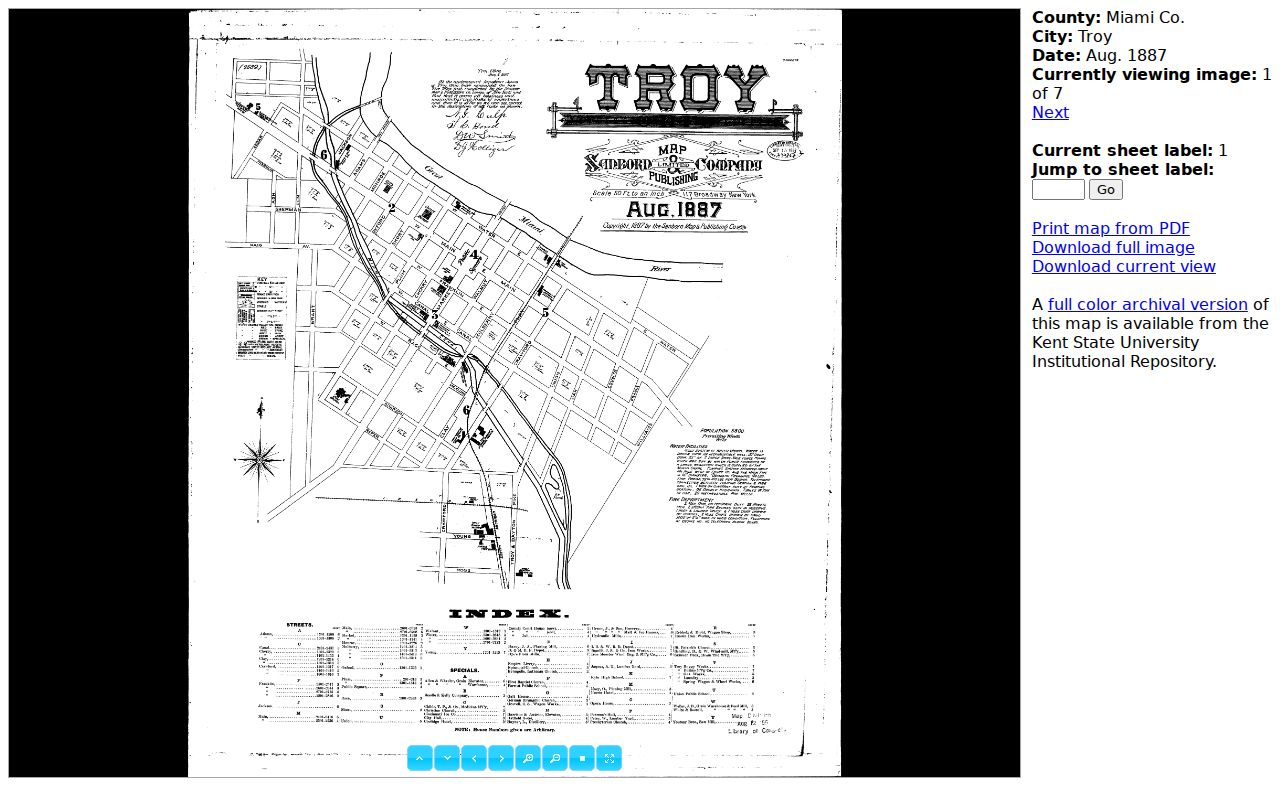
Match the directory address to the correct map date and sheet before drawing conclusions about a building or neighborhood.
Note: A Sanborn sheet shows a place at a map date; it does not identify every person who occupied that place.
Troy Historical Research Files
When a directory does not settle a family question, the Troy Historical Society subject files offer focused leads. The inventory lists church and denomination files, Black-history material, the 1834 to 1847 Manumission Record, Miami County 1810 and 1816 tax records, the 1860 mortality schedule, naturalization declarations, school and organization material, military records, deeds, wills, and family folders. It is an inventory of material to ask about, not a public online person database.
The Historical Society subject-file listing shows the breadth of those local research leads.
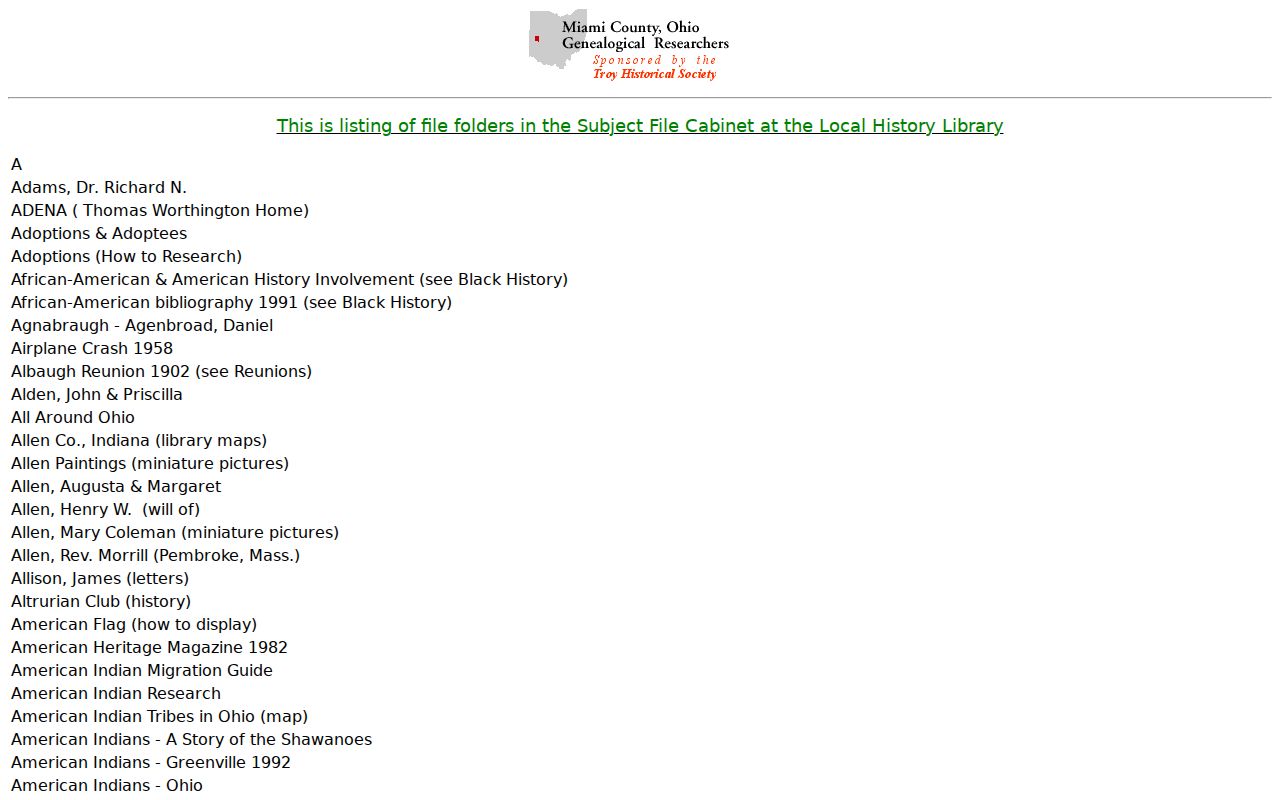
Staff can confirm whether a named subject file, family folder, or microfilm item is available before the researcher relies on it.
For early estate context, Common Pleas inventory books from 1807 to 1821 are described as fragile and appointment-only, with digital copies available through Local History. Their index can point to a deceased person, township, book, page, and year, but it does not guarantee a household street address.
Counter Research for Troy Directories
Use an in-person or staff-assisted route when the catalog omits the exact year, a volume is library-use-only, the record does not identify its arrangement, or an older address needs maps and microfilm. Bring the exact surname spelling, date range, known street names, and the catalog identifier if one exists. Ask whether the relevant item is a city, telephone, householder, or reverse directory before describing it in notes.
The Center, Historical Society, and their shared collection are better local fallbacks than a broad web query for an unverified volume. Historical material should be used for personal, lawful research. Do not use records to stalk, harass, or harm another person.