
Previous Residents of Troy Addresses
A backward address trail in Troy has distinct eras. The Miami County Auditor Property Search supplies the current parcel anchor. The Recorder’s books and indexes identify recorded transfers. Local newspapers, city-directory volumes, and Sanborn maps can add dated context, but each has its own coverage and access limit. Begin with the era nearest the question, then move toward older material only after recording the parcel and legal description. That approach reduces the risk of connecting a similar address, a similarly named party, or a changed street name to the wrong property.
| Source | Local period | Where held | What it adds |
|---|---|---|---|
| Deed book images | 1807–1979 | Laredo or Recorder assistance | Recorded chain and legal-description clues |
| Deed partial index | 1980–2008 | Book, page, or instrument route | Bridge era requiring verification |
| Indexed Recorder records | 2009–present | AVA or Laredo | Modern recorded instruments |
| Troy newspapers | 1828–2014 | TMCPL in-house access | Notices and address context |
| Troy Sanborn maps | 1887–1947 composite era | Ohio Web Library or TMCPL | Dated building and street setting |
For a more recent transfer, start with the parcel and Recorder route. For an older address, preserve the lot, block, or survey language before searching a directory, newspaper, or map collection.
Troy Previous Residents Era Map
The Miami County Recorder’s access instructions explain why one web search does not cover every period. As of October 30, 2024, documents from 1998 forward may be searched online by name or book and page. The stated 1980 through 1998 route is book and page. Deed-book images extend from 1807 through 1979, while the deeper digitized index groups and Recorder staff are the fallback for earlier or unevenly indexed material.
The County’s era divisions are access rules, not proof that a document disappeared. For the 1980s and 1990s, cross-check the Geographic Index. For older work, ask for help with the Geographic, Green Abstract, Name, or Miscellaneous Index rather than assuming a failed basic search closes the trail.
The free Recorder AVA search is the name-oriented, watermarked route. It is useful after an address search supplies a party name, but it is not an address index for every historic instrument.
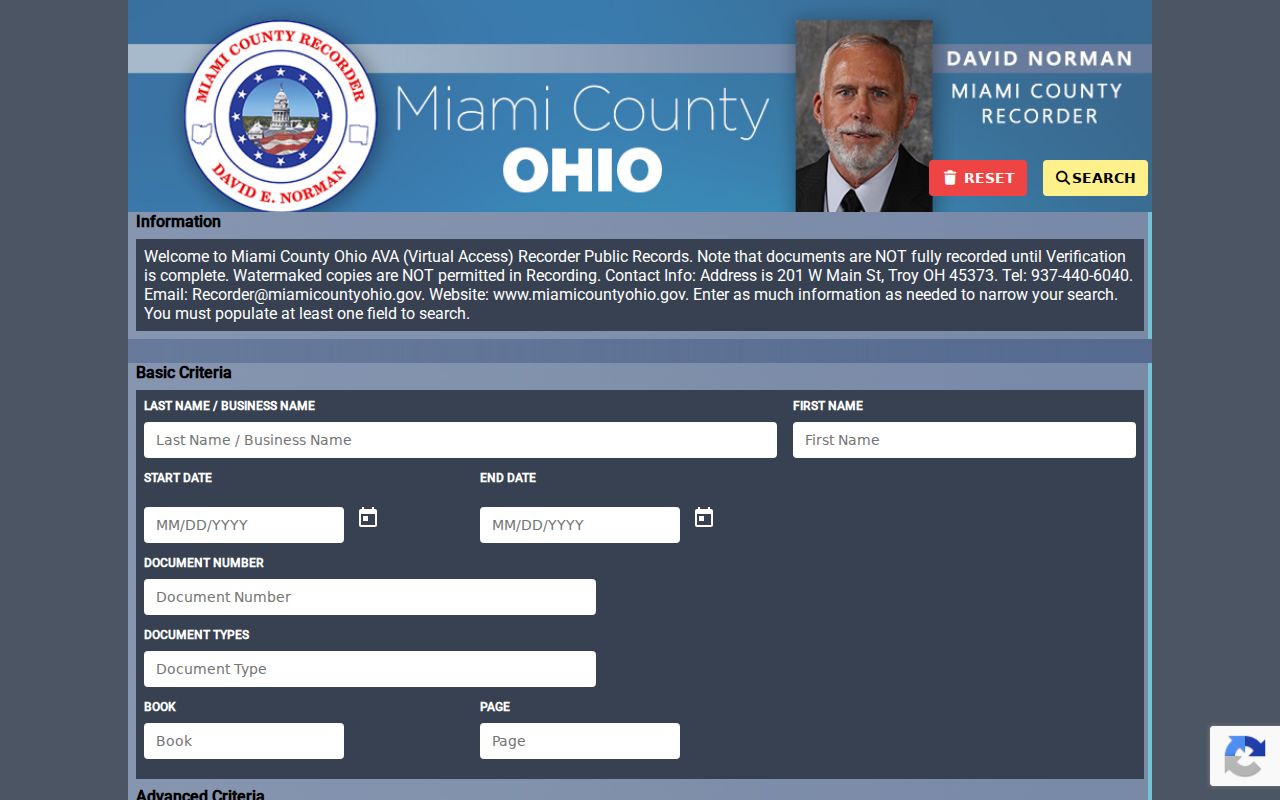
The Recorder screen reinforces the required shift from a street address to party, document, book, page, and legal-description research.
Troy Previous Residents Deed Trail
Trace the recorded ownership chain from today’s parcel backward. The Recorder directs users to name or book-and-page searching because addresses and parcel numbers are absent from some instruments. A deed trail records transfers of an interest in land. It does not, by itself, establish who occupied the address at a particular time.
- Use the Auditor’s address or parcel route to identify the parcel, situs address, legal-description clues, and current recorded-owner context.
- Search the owner or prior party through AVA or the Recorder’s index route, then open the relevant document record.
- Write down the recording date, grantor, grantee, document number, book or page, and legal-description details that appear.
- Search the seller or earlier grantee, then repeat the process while matching the same lot, plat, or legal description.
- Move to Geographic Index, book-and-page, Tax Map, or Recorder-help routes when the web index is incomplete for the era.
- Grantor and grantee
- The grantor transfers an interest in land; the grantee receives it in the recorded document.
- Chain of title
- The succession of recorded instruments used to study a property’s documented transfer history. It is not a legal title opinion.
- Legal description
- The lot, block, subdivision, survey, or metes language that identifies land more reliably than a changing street address.
Troy Recorder Index Gaps
Miami County’s digitized Name Index Books exclude 1917 through 1920. A nonmatch in that interval calls for a different method: use the Geographic Index, legal description, book and page, Tax Map material, or Recorder staff assistance. It does not justify a conclusion that there was no recorded event. The County also advises a Geographic Index check for the 1980 through 1999 period, where indexing needs verification.
For January 2009 through April 2014, the County’s Laredo instructions require OR before the book number in a book-and-page search. These small method changes matter when tracing an address across decades.
Troy Sanborn Address Dates
Ohio Web Library’s Troy Sanborn menu lists 156 images across eight dated sets: 1887, 1892, 1898, 1905, 1911, 1923, 1931, and the 1931–47 composite. These maps show building outlines, property boundaries, building use, and neighborhood context. Match the historic address to the correct dated sheet before deciding that a building or street reference belongs to the property in question.
The TMCPL Sanborn resource describes how the maps can help locate buildings and neighborhoods. A map is powerful supporting context, but it is not proof of personal occupancy. Pair it with a dated directory, notice, deed, or probate record.
Troy Historic Street Variants
Older downtown research needs more than the current street string. The City design history says Troy’s first 87 lots were platted in 1807, with Water, Miami, Franklin, and Back among the early streets; it says Miami and Back later became Main and Canal. A Historical Society account agrees on Back-to-Canal continuity but differs on the early Miami or Main wording. Test the variants, early lot references, and historic maps rather than discarding a record because its street label is unfamiliar.
Later annexation also changes an address’s municipal setting. The City’s map layers show annexation by year, while D08 and D45 parcel prefixes identify property within Troy corporate limits. A Troy mailing label alone is not the final jurisdiction answer.
Note: Map the street as it was named in the record’s date range before linking an older entry to a present parcel.
Troy Household Research Trail
Past residents are most carefully studied by pairing land evidence with dated local context. The Troy-Miami County Public Library Local History & Genealogy Center holds directories, newspapers, maps, wills, land records, microfilm, public computers, and research support. Its historic newspaper access covers Troy material from 1828 through 2014, and staff can help distinguish a catalog lead from a usable item. The Center is an in-person research resource, not a universal household database.
- Choose a dated directory, newspaper, or map item that fits the property era.
- Capture the exact spelling, address, business or residence distinction, source title, year, and page.
- Compare the item with the nearest released federal census and a recorded land or probate clue.
- Check a second date before treating the address association as a continuing household connection.
For the historical shelf itself, use the Troy city directory page alongside the catalog and Local History staff. The known 1898 Hollis and Oakes example distinguishes George Barton’s N. Cherry residence from his Public Square studio, a useful reminder that business and residence references are not interchangeable.
Troy Probate and Obituaries
Probate and death material can help close a property story without replacing the deed chain. The Miami County Probate genealogy route lists estates, guardianships, trusts, and miscellaneous records from 1807 forward, marriages from 1807 forward, births from 1853 through 1908, and deaths from 1867 through 1908. A probate file may connect an estate to a property or heir question, but its contents and public access depend on the specific record.
The Probate genealogy page is the official local starting point for this older-record channel.
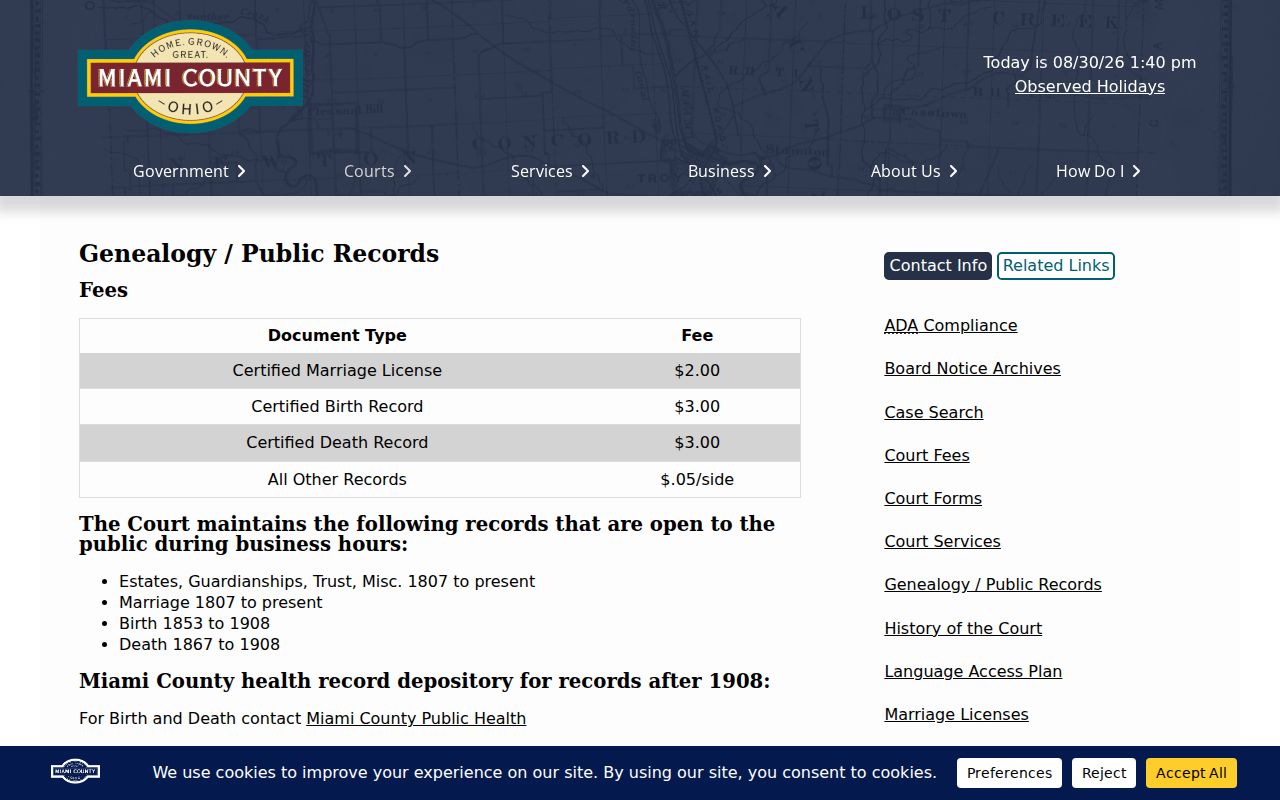
This channel complements a deed chain by providing an estate and vital-record bridge for the appropriate historical period.
For statewide historic death research, the Ohio History Connection death index displays specified eras, including 1913–1944 and 1954–1970, while its stated holdings reach from December 20, 1908 through 1970. Keep index display coverage separate from held-copy coverage.
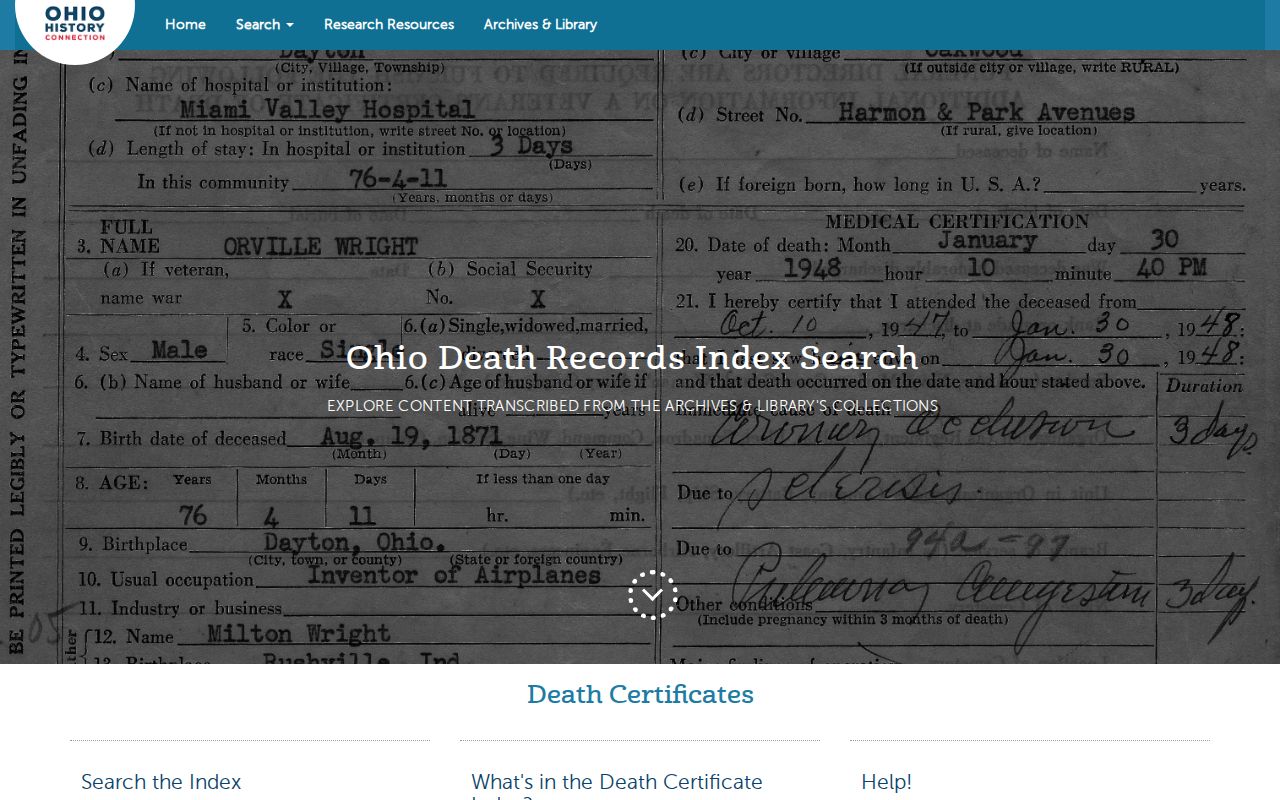
The historical index can supply a name, year, county, or certificate lead to be checked against the correct custodian and address trail.
Troy Local History Help
The Troy-Miami County Public Library Local History & Genealogy Center is the documented local fallback when an address question reaches a fragile index book, a directory-shelf question, newspaper microfilm, or a map. It is at 510 W. Water St., Suite 210, Troy, and shares its current setting with the Troy Historical Society. Verify current hours before visiting. The Center also has digital resources, copy services, and research staff.
Its posted schedule is Monday and Wednesday from 10 a.m. to 7 p.m.; Tuesday, Thursday, and Friday from 10 a.m. to 4 p.m.; and Saturday from 10 a.m. to 2 p.m. The library says its former local-history room dates to 1960, its Historical Society partnership to 1965, and the present shared Center to a 2025 move to Hobart Government Center.
The Troy Historical Society’s subject-file inventory can also direct a focused inquiry toward early tax records, church and organization files, deeds, wills, schools, military material, or family folders. It is an inventory for in-person discovery, not a public person database. Ask staff whether a named item is available before treating it as part of an address trail.
The Troy directory catalog identifies a Troy Library Reference Collection copy for 2002 as library-use-only. Other listed dates belong to named shared-system branches. That distinction keeps a Troy shelf question precise and avoids treating the catalog as proof of an uninterrupted local run.
No official Troy house-history guide was located, and no verified local reverse-directory title or year run was found. Ask staff about a particular year, address, or volume rather than filling a gap with an assumed resource. For early estate inventory material, the Historical Society notes that the 1807–21 Common Pleas inventory books are fragile, require advance notice, and have digital copies available through Local History.
Lawful use. Troy house and family-history research should remain personal and lawful. Do not use a historic address trail to stalk, harass, intimidate, or harm any living person.